Nothing compares to the quiet theater of a savannah sunrise when viewed from a wide-open veranda. “Savannah horizon verandas” are more than pretty decks; they’re front-row seats to an ancient rhythm—zebra lines moving like brushstrokes, giraffes tipping the skyline, and the soft brass of dawn rolling across the grass. The best safari retreats design these spaces as living rooms at the edge of wilderness: shaded, airy, and oriented to the horizon so every hour feels like a private screening of the plains. Here, the promise is intimacy without isolation—luxury that doesn’t drown out the soundtrack of wind, wings, and distant hoofbeats.
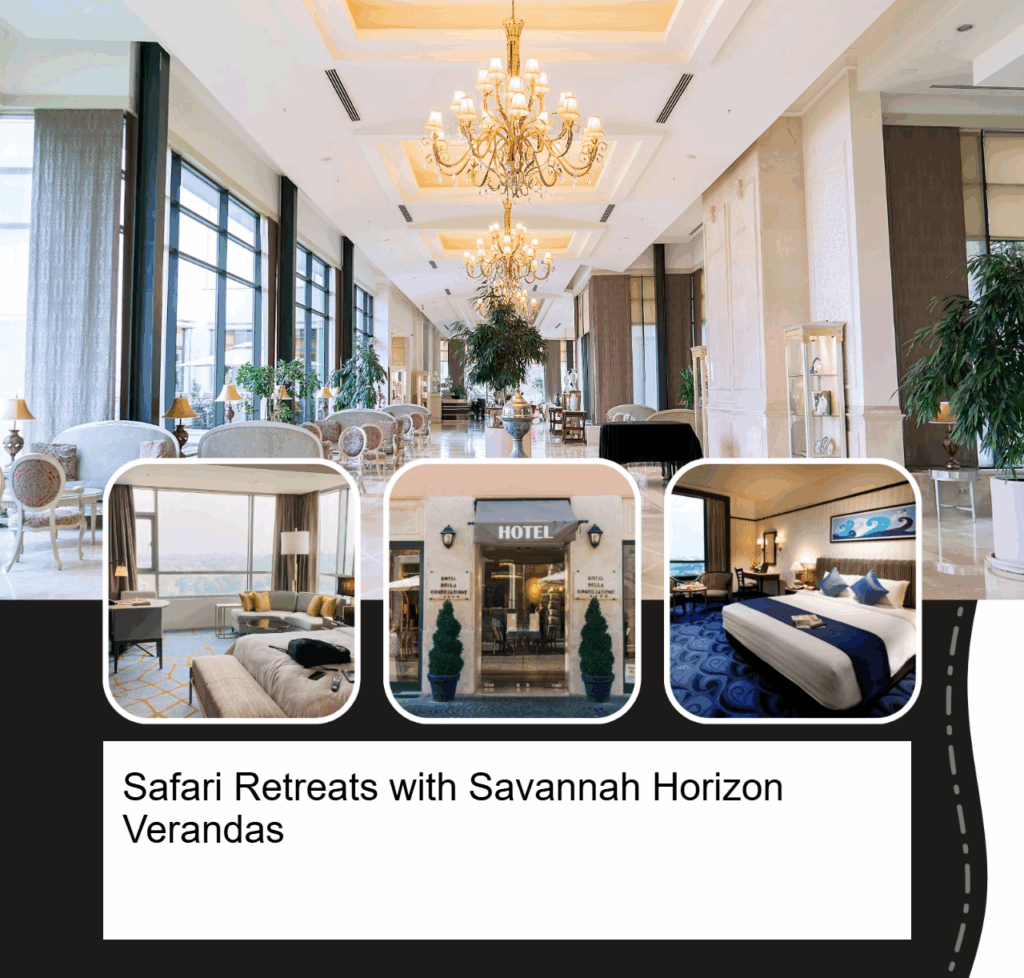
The Golden-Hour Veranda
At first light, the veranda becomes a hush chamber. You sip coffee while the horizon brightens from pewter to honey, and your guide quietly points out silhouettes—elephant, then impala, then a lone wildebeest testing the air. Verandas facing east catch the earliest warmth, with deep eaves and canvas awnings to soften the glow. Designers often choose natural textures—oolitic stone, reclaimed teak, woven grasses—so the threshold between lodge and landscape feels seamless. You’ll notice low, lounge-height railings or pergola slats positioned to frame binocular views without sacrificing comfort, so you can watch the plains come alive without ever leaving your chair.
Waterhole Watchposts
Some verandas are anchored to a reliable water source—a pan, a seasonal stream, a pumped waterhole—turning afternoons into long, luxurious stakeouts. Daybeds and swing chairs invite unhurried gazing as concentric rings of wildlife rotate in: warthogs first, then kudu, then a stately line of elephants. Discreet spotting scopes stand ready, while quiet-close doors and insulated floors keep your presence almost invisible. Late in the dry season, these verandas offer National Geographic moments without the vehicle: dust plumes, trumpeting contests, and the delicate etiquette of sharing scarce water—an entire ecology unfolding meters from your glass.
Starlight and Silent Fire
When the sun dissolves, the veranda shifts from theater to observatory. Lantern sills, recessed step lights, and ember-warm fire bowls preserve night vision so the Milky Way can run bright across the roofline. Many retreats pair their verandas with star decks—slightly raised platforms with loungers and hot-water bottles—plus a guide who can trace Scorpio to the southern horizon. You may hear hyena calls lift and drift, or the faint cough of a leopard in the mopane. With blankets, Amarula on ice, and a midnight snack, these verandas turn darkness into a velvet-textured amenity.
Design That Breathes the Biome
The finest savannah verandas are sustainable by design. Roof pitches harvest breeze; clerestory gaps vent hot air; adjustable louvres temper sun. Materials are chosen for thermal mass and light touch—local stone for foundations, tensile canvas for shade, and joinery built to be repaired, not replaced. Furnishings are tactile yet unfussy: linen slipcovers, stitched leather, hand-thrown ceramics. You’ll find binocular drawers, field guides, charging nooks, and weatherproof throws—quiet gestures that elevate comfort without stealing attention from the horizon. The result is a veranda that feels inevitable, as if the land itself requested a seat.
Q&A: Planning Your Veranda-Forward Safari
Q: Which retreats excel at horizon-facing verandas?
A: Look to Angama Mara (Kenya) for cliff-edge panoramas, Singita Sasakwa Lodge (Tanzania) for grand-manor terraces, Royal Malewane (South Africa) for plush privacy, Mombo Camp (Botswana) for wildlife-dense floodplains, and Tswalu Motse (Kalahari) for russet-dune vistas. Each pairs expansive decks with meticulous sightlines.
Q: Best season for veranda time?
A: The dry months typically offer thinner vegetation and concentrated wildlife at pans—prime for waterhole verandas. Green season brings electric skies, newborn animals, and painterly sunsets. If stars matter most, target cooler, clearer months with low humidity.
Q: Are veranda-centric safaris good for families?
A: Yes—private decks let younger travelers rest between game drives without giving up wildlife viewing. Consider andBeyond Phinda Rock Lodge (dramatic outlooks) or Little Kulala in Namibia (rooftop star beds) where downtime still feels like discovery.
Q: What should I pack for long veranda sessions?
A: Soft-soled shoes, neutral layers, a lightweight windproof, wide-brim hat, quality binoculars (8x or 10x), and a journal. Many lodges supply blankets and scopes, but your own optics make the difference.
Q: Any options for design lovers?
A: Zannier Hotels Sonop (Namib) channels vintage expedition romance; Sabi Sabi Earth Lodge (South Africa) blends biomorphic forms with earth-toned minimalism. Both elevate veranda life into a design narrative.
Conclusion: The Luxury of a Line on the Land
“Safari Retreats with Savannah Horizon Verandas” isn’t only a theme—it’s a way of traveling that prizes time, stillness, and precision. A well-placed veranda frames what you came to see while gifting you the quiet to feel it. You won’t tick boxes here; you’ll measure your days by light: the amber wash of morning, the white hush of noon, the blue-violet slide into night. Between drives, you’ll collect small miracles—dust caught in a sunbeam, oxpeckers skimming a buffalo’s back, constellations bright enough to cast a shadow. It’s exclusive not because it’s closed off, but because so few luxuries rival this: a chair, a horizon, and the world arriving on its own terms.