There’s a particular kind of Tuscan magic that unfolds where vine-striped hills meet artisanal craft: the hush between cypress shadows, the resin-sweet note of old barrel rooms, the cool of stone underfoot after the sun slips away. Vineyard Villas with Tuscany Driftwood Terraces captures that alchemy in full—an experience where architecture is carved from the land’s own memory. Imagine breakfasts on sunlit decks built from weathered driftwood, their pale grain soft against the hand; imagine evenings that taste of Sangiovese and rosemary as the valley turns gold, then violet. Here, luxury is less about spectacle than about precision: materials chosen for how they age, spaces designed for how they sound at dusk, hospitality tuned to the rhythms of harvest and hearth.
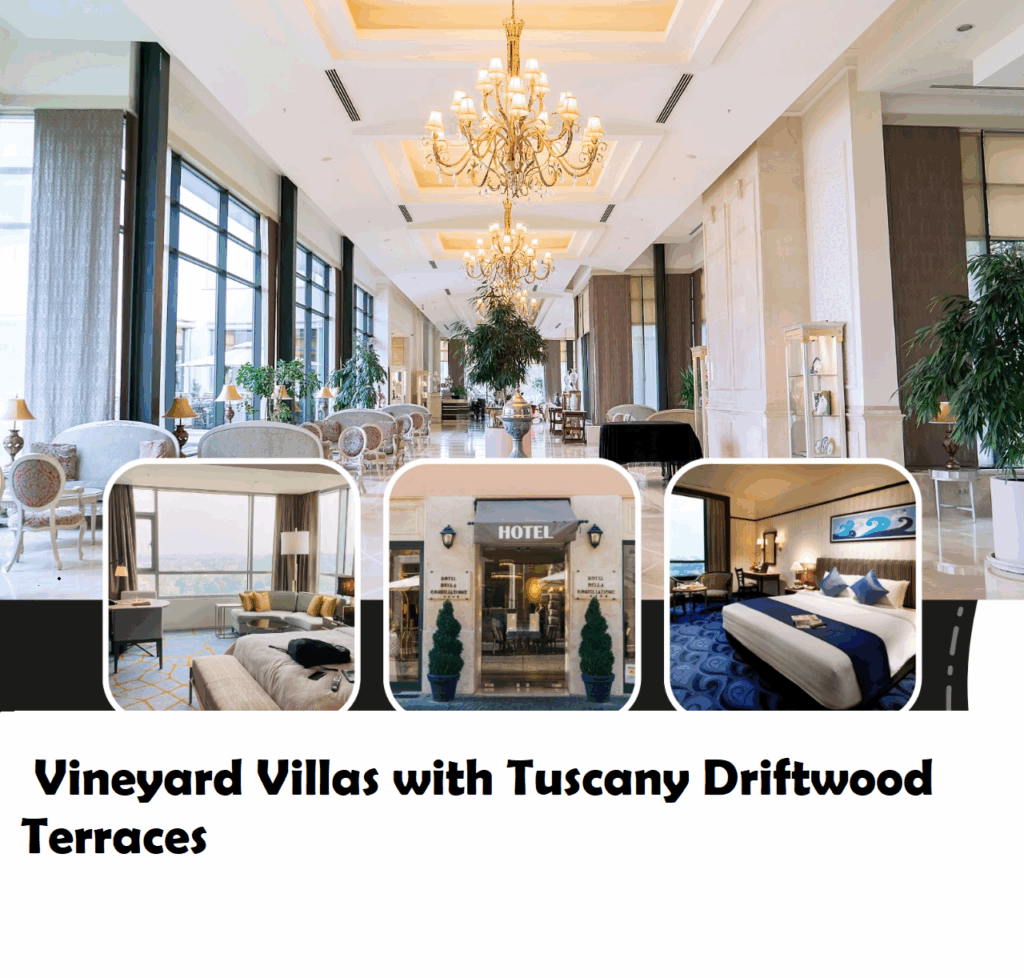
Sunlit Vines and Quiet Stone
Your first impression is the horizon—tiered rows of vines tracing the slopes like staff lines of a score. Villas are low and confident, dressed in limestone and limewash, with archways that funnel morning light into cool interiors. Doors swing open to terraces that feel more like belvederes than balconies: places to pause, breathe, and watch the day begin. Inside, linen sofas, hand-thrown ceramics, and woven reed panels dial back the visual noise. Each room is a still life—olive branches in a terracotta jug, a stack of art books, a bowl of apricots—curated to let the landscape lead.
Driftwood Terraces, Handcrafted Calm
The terraces are the signature. Planked in driftwood that’s been sanded by river and sea, they anchor the villa in a palette of silvers, ash, and soft tobacco browns. Underfoot, the wood is warm by noon and silky by night; overhead, a pergola lattices light into a moving pattern across linen tablecloths. A long table waits—iron-legged, heavy with grain—set for six or for two. You pour a glass, the glass fogs, and the valley breathes. One corner is devoted to idleness: sling chairs with canvas slung just so, a low bookcase with guides to Brunello producers, a brass bell to summon herbal tea or a late-afternoon affogato. When the wind carries the smell of cut hay or wet stone after rain, you feel the terrace gather those scents and hold them like an embrace.
From Barrel to Table
Food and wine here are not amenities; they are context. A private tasting starts in the cantina where cement eggs and old barriques line up like sentries. Your host pours a flight that maps the soil layers beneath your feet—galestro, alberese, clay—and you begin to taste texture as much as flavor: the chalky snap, the sanguine depth, the fennel-thread finish. Dinner is a choreography of proximity: tomatoes from the garden that morning, lamb rubbed with wild thyme from the slope beyond the pool, a panna cotta flecked with honey from the neighbor’s hives. If you want ceremony, there’s candlelight and silver; if you want simplicity, there’s grilled bread, olive oil, salt, and a view good enough to count as a course.
Slow Living, High Design
Wellness is unhurried and elemental. A lap pool edged in pietra serena extends toward vines; a cedar hot tub steams under a blanketing of stars. Massage tables are set on the terrace so the breeze can do its part; the oil smells faintly of cypress and lemon leaf. Mornings might begin with a guided e-bike glide to a hilltop borgo for espresso; afternoons might end with a siesta behind gauzy curtains or a sketching session at the farmhouse table. Nothing asks for your attention; everything holds it.
Q&A + Discreet Recommendations
Q: What makes these villas different from a standard luxury stay?
A: Material honesty and terroir-led design. Driftwood terraces, stone, linen, and patina create calm that feels lived-in rather than staged. Service is intuitive—present when needed, invisible when not—so the day can stretch and breathe.
Q: When is the best time to visit?
A: Late spring (April–June) for wildflowers and soft temperatures; early autumn (September–October) for the vendemmia harvest energy and luminous light for photography.
Q: Which properties echo this mood?
A: Consider Rosewood Castiglion del Bosco for Brunello heritage and cinematic landscapes; Borgo Santo Pietro for artisanal craft and garden-to-table finesse; Monteverdi Tuscany for contemporary design threaded through a medieval hamlet; Il Borro Relais & Châteaux for a living village ambience; and COMO Castello del Nero for wellness-forward equilibrium and broad Chianti vistas.
Q: What experiences pair perfectly with the setting?
A: Sunrise hot-air ballooning over the Val d’Orcia; truffle foraging with a tartufaio near San Miniato; a private pasta class on the terrace; e-biking vineyard-to-vineyard with a picnic in a cypress grove; sunset tasting flights focusing on Sangiovese clones.
Q: Any quick tips for capturing the moment?
A: Shoot during golden hour with the terrace planks as leading lines; soften highlights with a linen napkin over the lens for a gentle diffusion; frame a glass of red against the horizon for scale and warmth.
Conclusion: An Invitation to Belong
Vineyard Villas with Tuscany Driftwood Terraces is an ode to belonging—the feeling that the landscape has made room for you and your days fit its cadence. It is luxury pared down to intention: mornings carved from light, afternoons stitched with olive shade, evenings tuned to the quiet percussion of cicadas. On these terraces, time behaves differently; meals take longer, conversations deepen, and the horizon becomes a kind of promise. Come for the wine, the craftsmanship, and the view; stay for the rare calm that follows you home like the scent of thyme on your hands. This is exclusivity not as distance, but as depth—an experience that lets you live closer to what matters, one long, sun-warmed evening at a time.